

It’s being said that there is a masculinity crisis in America. There is a male loneliness epidemic in America. Both of these statements are being made a lot on social media and in other forums seemingly on a daily basis. The bitter irony is that the ones making these statements are the ones who are at fault for both. Allow me to explain. The masculinity crisis and the problem of men being lonely are both driven by toxic masculinity. It’s fueled in part by what Dr. Greg Carey recently called a cult of gender essentialism and heteronormativity on an episode of the God Squad Pod. This nonsensical and unscientific social construct can be seen in the work of fundamentalists like John Piper and in the bigoted, misogynistic, and sexist “Nashville Statement” which was released in 2017. I wrote a rebuttal to the Nashville Statement while in seminary which is included in my book Theological Musings Volume 1. It can also be seen being pushed by the Trance Regime by a poster child for fragile and toxic masculinity named Pete Hegseth as he lamely attempts to prove just how tough and manly he is through performative stunts, spouting off about wokeness, and purging the military of highly qualified people simply because of their gender. He goes to church in a denomination whose leader believes that marital rape isn’t real because women are there to please men without regard to their own needs or consent.
Just yesterday, the current President, a self admitted sexual predator, was asked by a journalist about the Epstein files. The journalist in question was a woman from Bloomberg. The Predator in Chief responded by pointing in the woman’s face and saying “Quiet, piggy.” The journalist was simply doing her job and Trump responded with vile misogyny. No one else in the press stood up for her in the face of Trump’s disgusting behavior. Imagine if Biden or Obama had said that to a Fox News journalist. Trump has repeatedly shown America and the world who he is for DECADES with his words and actions. Too many people either didn’t believe him when he told the world of his toxic behavior or they simply agree that that’s how a man should be.
There are other men on the Internet who are also gaining large followings by spreading vile, abusive, and evil misogynistic rhetoric under the guise of being a “real man.” I come across this garbage all the time on social media and do what I can to expose it for the absolute horseshit* that it is. Andrew Tate, the hyper-misogynist predator, for example recently claimed that all women are scum on social media. He has millions of followers. Perhaps he is full of self-loathing because he is secretly gay and buys into the toxic lie that there is something wrong with being gay. Perhaps he just chooses to be an awful human being who is known to have abused women. Either way, no man should be listening to him and those like him for advice on how to be men.
Many Christians, generally conservative ones, claim that the Bible defines strict gender roles and androcratic male-headship. There are texts that support that view within the canon. That said, as with so many topics in the Bible, the various texts are not consistent, but they are contextual to a time and place in the Ancient Near East during the Iron Age. It’s time to stop treating those texts as prescriptive for all times, all places, and all peoples. Besides, a careful reading of the biblical texts shows that some of the social constructs espoused within those texts changed over time, often due to changing political or military circumstances. As one early example of this inconsistency, see Genesis chapters 1-2. Chapter one has God creating humanity in God’s image simultaneously, which tells me that the person or persons who wrote that version of the creation narrative did not see a male-female hierarchy as divinely sanctioned. Chapter two tells a completely different creation story in which the writer or writers does see a male-female hierarchy. In other words, the inconsistency on this topic starts in the first two chapters of the first book of the Bible. We should read these texts critically and separate the wheat from the chaff. In this case, patriarchal assumptions are that chaff.
There are other stories in the Hebrew Bible which show women turning patriarchal ideas upside down. Among these are the stories of women such as Tamar, Hagar, Ruth, and Esther. Each woman in those biblical stories stood in her power to change their circumstances by upsetting the androcratic apple cart. Likewise, in the Gospel narratives, we can see Jesus throwing a wrench into the patriarchal engine as well. He engages with, interacts with, and stands up for women in ways deemed inappropriate by many of the religious leaders and other people of his time. In John’s Gospel, Jesus stops a mob of angry men from stoning a woman to death for adultery. That mob didn’t seem at all interested in stoning the man she was ostensibly with though, they only target the woman. Jesus told them that only a person without sin could throw the first stone and stopped them in their tracks thus sparing the woman from their patriarchal misogynistic wrath.
In Luke’s Gospel, Jesus goes to eat dinner at the home of Simon the Pharisee. While there a woman, who is called a sinner in the text without naming the sin, comes to anoint Jesus’ feet with ointment and washes his feet with her tears. Simon is incensed, such is is his religious pride, that Jesus doesn’t know what kind of woman he is allowing to anoint his feet. Simon seems to think that he himself is without sin. Alas, none of us are, regardless of how we view sin. Jesus, being Jesus, turns Simon’s thought process on its head by telling a parable. After telling the parable, he turns to look at the woman, but speaks directly to Simon saying, “Do you see this woman?” To me, he is asking Simon to see the woman’s humanity instead of dehumanizing her simply as a worthless sinner. Jesus then let’s Simon know all of the ways in which Simon failed as a host while highlighting how the woman treated Jesus better.
Jesus also had women disciples and it was some of those women, and only women, who proclaimed his resurrection in all four gospel narratives. That also flips patriarchal norms completely over in my theological opinion because the women took the lead. Then of course there is the golden rule, which Jesus states in Matthew 7:12 as “In everything you do, do unto others as you would have them do unto you.” Toxic masculinity, of which patriarchal and androcratic beliefs are a part, is an easily identifiable violation of the golden rule. None of the women I know want to be told that they are less than because of their gender/sex, that they should only serve men by being pregnant and subservient, or be abused mentally, physically, or sexually by men. Men who believe that women are here for them to command, to hold back, or to abuse are pathetic, fragile, and weak.
But Dillon, Paul says…
Paul’s authentic writings affirm that women were leaders in the early Jesus movement. They prayed, prophesied, and evangelized according to Paul himself. Later writers who the majority of scholars beleive were writing in Paul’s name apparently did not like what Jesus’ most famous proponent had to say about women in leadership and thus wrote letters that directly contradict what he had actually written. But Dillon, Paul did write 1 Corinthians, and it says…
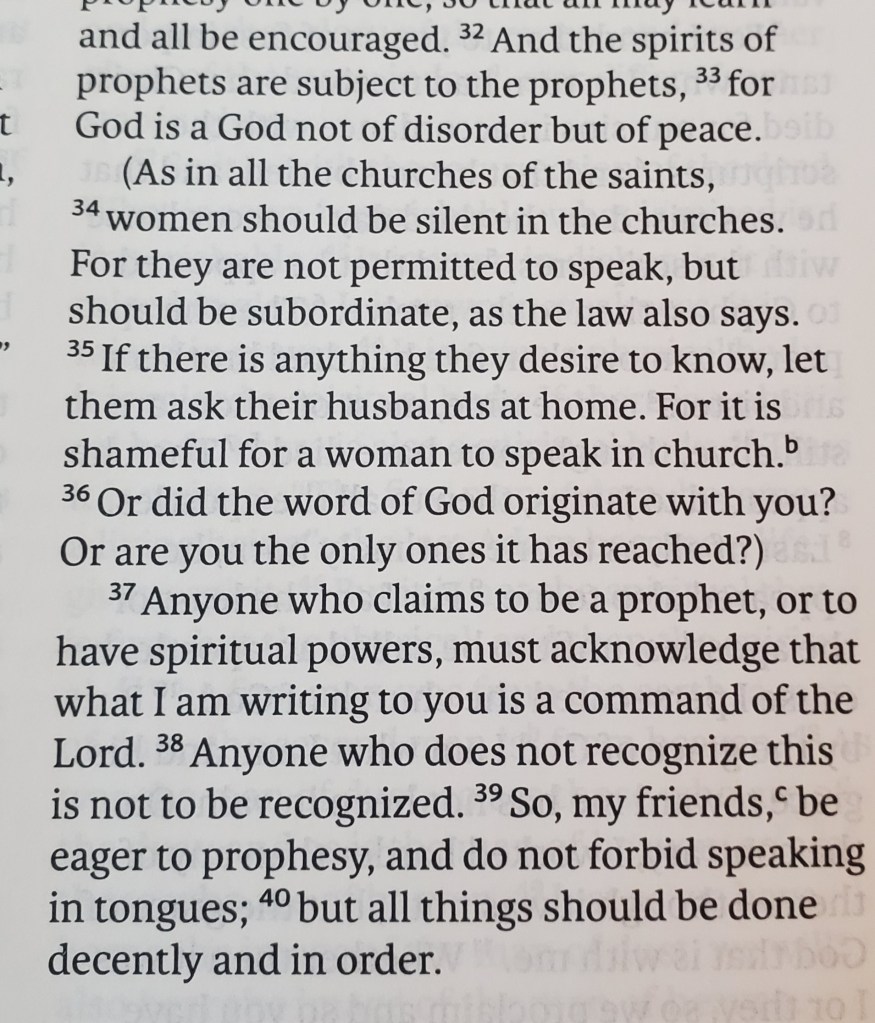
Yes, Paul did write 1 Corinthians, and there is a passage in chapter 14 that “women should be silent in churches.” Once again, that is not a passage written by Paul. We know this because it contradicts what Paul said in 1 Corinthians chapter 11, and because that passage in chapter 14 completely disrupts the flow of Paul’s argument in that chapter. It literally makes no sense in the context of what Paul was saying. For that reason, scholars have identified it as an interpolation by a later scribe. Those scribes, like the writers of the pastoral letters for example, didn’t like the egalitarian language Paul uses in his authentic writing related to gender/sex and inserted that sexist argument into later editions of the text. In some Bibles, that passage is shown in parenthesis to show readers that it is not in the original epistle. Skip those verses next time you read 1 Corinthians 14 and it makes a lot more sense.
The patriarchal views espoused by toxic men are about male domination. There is nothing in the teachings of Jesus that I can find that even remotely suggests that men should dominate anyone– not women, not enemies, not people of other faiths. There is no scientific basis for gender essentialism. It’s just a patriarchal social construct that often leads to dehumanizing women, to emotional abuse, physical violence, and sexual assault by men who believe that women are their property or simply for their pleasure. The men who continue to espouse it and enact it deserve to be lonely. Far too many of them, including Trump and multiple members of his administration, deserve to held legally accountable for crimes against women. The truth is, women don’t owe men anything. Men on the other hand ow everything to women, including standing between them and men like Joel Webbon who want to take away their rights.
Toxic patriarchal masculinity harms women. It harms men too–deeply. Harmful and oppressive ideologies should be thrown into the dustbin of history where they belong. There are examples of positive, supportive, non-toxic masculinity in the world, whether they are real people like Fred Rogers and Jalen Hurts, or fictional characters like Ted Lasso. Unfortunately, they are often drowned out by defenders of the patriarchy from their poisonous pulpits, press conferences, and social media accounts. To my fellow men, stand up for women by calling out toxic masculinity and actively participating in smashing the patriarchy to smithereens. To do anything less is to be complicit.
The following screenshots are examples of toxic masculinity that I have encountered in the past week online as well as examples of men pushing back against it.
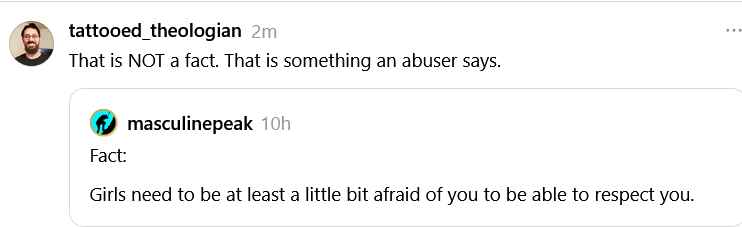


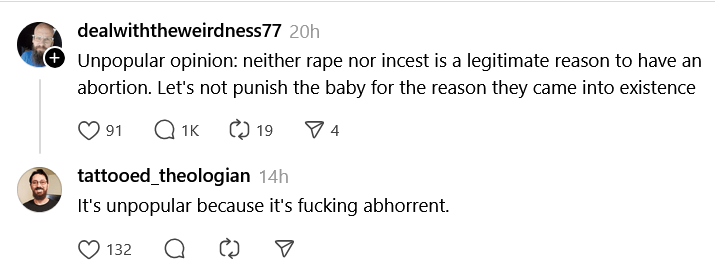
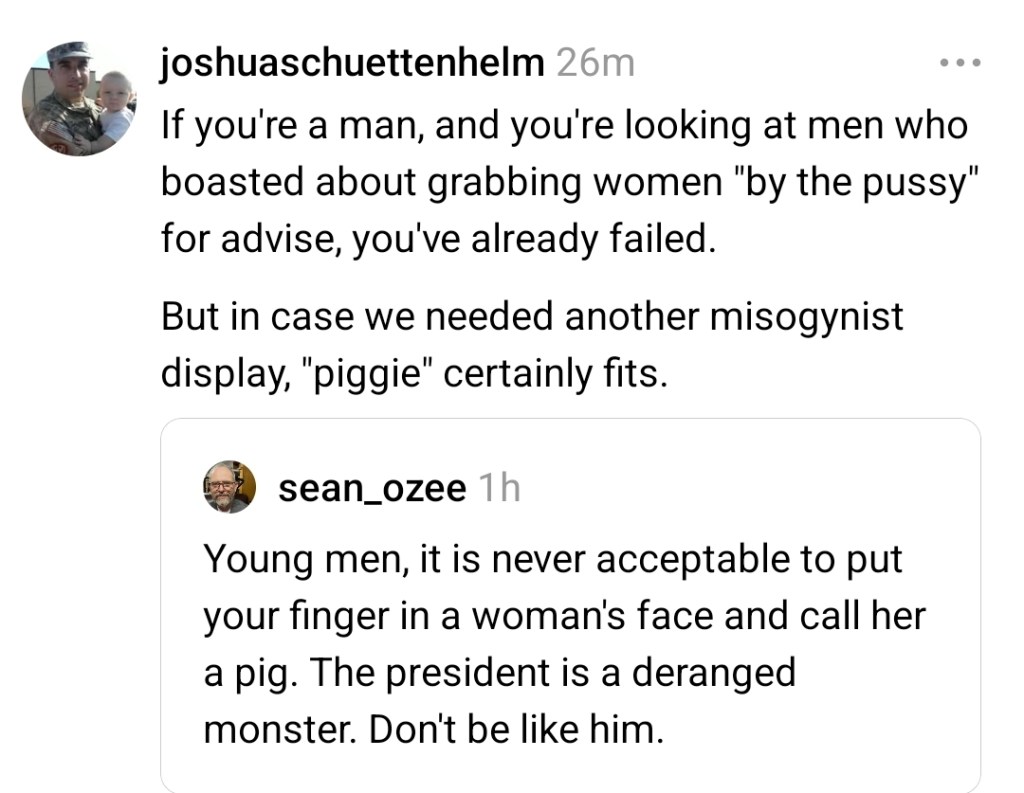
*Please do not be more upset that I used the word “shit” than you are about the heinous and dangerous rhetoric of toxic masculinity. The Apostle Paul used the word ‘shit’ in his letter to the Philippians.
 The Tattooed Theologian