

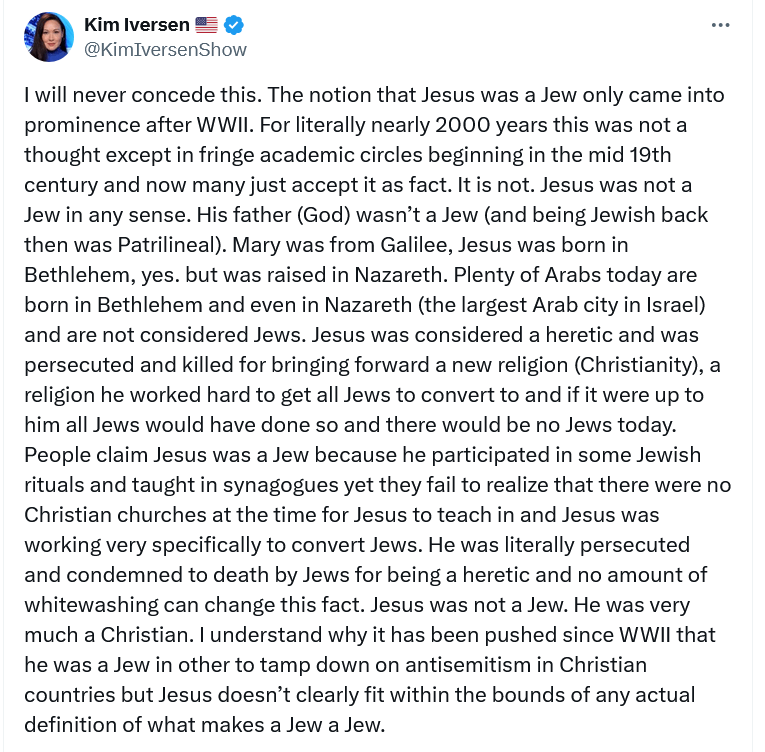
Recently, a woman named Kim Iversen, sent out a tweet that has since been seen by over 3.5 million people. She is a media personality, having hosted shows on multiple radio stations, and now finds herself on Rumble the alt-right video platform. In her tweet, Iversen stated that “the notion that Jesus was a Jew only came into prominence after World War II.” I’m sorry, what??? A tweet this absurd perhaps shows us why Ms. Iversen finds herself on Rumble these days instead of working for a reputable network. The only times I have ever seen someone make the claim that Jesus wasn’t actually Jewish is by Neo-Nazis and other antisemitic white supremacists. I don’t know if Iversen is a white supremacist, Neo-Nazi, but she is spouting the same kind of rhetoric that they do. She also claimed that Jesus “was considered a heretic and was persecuted and killed for bringing forward a new religion (Christianity), a religion he worked hard to get all Jews to convert to and if it were up to him all Jews would have done so and there would be no Jews today.” Again, this is not only demonstrably false, but patently ridiculous.
Jesus was a Jew and I cannot believe this has to be said in 2024. Not only that, he was a devout Jew whose religion was Judaism. During his lifetime, his preaching was primarily to the Jewish communities where he taught. Jesus was not attempting to start a new religion called Christianity, but rather he was a reformer of Judaism in the Second Temple period whose teachings often focused on what was best for people rather than hyper rigid legalism in regards to the Hebrew Bible. The idea that no one thought Jesus was Jewish until after World War II is farcical. We have plenty of evidence to refute such an outlandishly stupid and dangerous claim. Let’s take a brief look at some of that evidence.
The Gospel of Matthew is the most Jewish of all the Gospels, meaning that the author of Matthew repeatedly highlights Jesus’ Jewishness and his adherence to Judaism. In his introduction to Matthew in the New Oxford Annotated Bible 4th edition, NRSV translation, scholar of early Christianity J.R. C. Cousland notes that, because the author “draws most extensively on the Hebrew scriptures, Matthew functions as a bridge between the two testaments.” He goes on to say the Gospel of Matthew’s “high regard for the Jewish Torah (5:17-20; 23:1-3) is noteworthy, as is the extensive use of prophecies from the Hebrew Bible, and its occasional disdain for non-Jews (5:47; 6:7,32; 16:17).” (Cousland, pp. 1746-47) Corroboration of Cousland comes from well known scholar Bart Ehrman whose chapter on Matthew in his excellent book The New Testament: A Historical Introduction to the Early Christian Writings is entitled “Jesus, the Jewish Messiah,” and he notes that “Matthew has tried to emphasize the Jewishness of Jesus and to stress that his followers need to adhere to the Jewish law.” (Ehrman, 114) As to the claim that Jesus was trying to start a new religion and there would be no more Jews once they all converted, Biblical scholar Mark Allan Powell notes in his textbook Introducing the New Testament that the author of Matthew was a Jewish Christian (writing decades after the death of Jesus) who alone of the Gospel writers “is adamant that the original ministry of Jesus was directed solely to Israel. (10:5-6; 15:24; cf. 28:17-20” (Powell, 108) Jesus was a Jewish teacher who primarily taught Jewish people. If anyone was trying to create a new religion, it was Paul.
Even if one does not have access to an excellent study Bible or to textbooks written by Biblical scholars, there are definitive clues in the Gospels and elsewhere in the New Testament that Jesus was Jewish and that his early followers were as well. Jewish men were distinct in the Ancient Near east because of their practice of circumcision. Male children were to be circumcised on the eighth day after their births. Such it was with Jesus as we can read in Luke 2:21-39 that he was circumcised on the eighth day and taken to the Temple for the ritual purification “according to the Law of Moses,” (Luke 2:22). Later in the passage the Jewish man Simeon proclaims that, This child is destined for the falling and rising of many in Israel,” (Luke 2:34). Later in Luke, Jesus announces his ministry by going to the synagogue and reading from the scroll of Isaiah. Jews are the only people in Jesus’ time who went to synagogue or performed rituals according to Mosaic law. Matthew’s gospel is clearly not the only gospel narrative that shows Jesus’ Jewishness. Clearly Ms. Iversen has not read her Bible very carefully.
The above examples are only a few of all the examples in the New Testament. Many are quite easy to spot without too much trouble. We see Jesus in the “travel narrative” in Luke making his way towards Jerusalem for the Passover celebration, he teaches in synagogues and in the Temple, and people touch the “fringe of his mantle” for healing (Mt. 14:36) – the mantle in question being the Jewish prayer shawl worn by Jewish men. During the Transfiguration, Jesus is seen with Moses and Elijah on a mountaintop by his disciples Peter, James, and John (Matthew 17:1-8; Luke 9:28-36). Moses and Elijah are of course two of the most important people in the Hebrew Bible. Jesus drives money changers out of the Temple (which happens in all four gospels, though at different times depending on the writer) and he is also proclaimed to be the Jewish Messiah by his followers. In other words, Ms. Iversen’s claims that no one thought Jesus was Jewish until the 1940s is beyond absurd, but not at all funny. I suggest that in addition to her Bible, if she actually has one, that she read Dr. Amy-Jill Levine’s thought provoking and illuminating book, The Misunderstood Jew: The Church and the Scandal of the Jewish Jesus to disabuse herself of the kinds of notions that white supremacist Neo-Nazis hold on to.
Peace be with you.
P.S. My latest book Theological Musings: Collected Essays of a Tattooed Theologian Volume 2 is now available from Quoir Publishing.
 The Tattooed Theologian
Pingback: I am a Heritage Jew – Darhlene.com